How does π-conjugation affect optical absorption?
A reproducible comparison of biphenyl, p-terphenyl and p-quaterphenyl absorption spectra in cyclohexane, using published PhotochemCAD data.
Phenyl-ring series
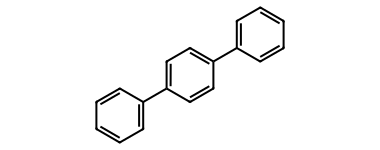
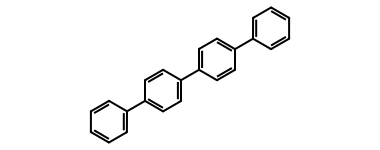
Does adding a para-linked phenyl ring move the principal absorption band to a longer wavelength? Biphenyl, p-terphenyl and p-quaterphenyl provide a small homologous series with two, three and four rings. All three records report cyclohexane as the solvent.
Spectra measured by Ruchun A. Fuh in 1995, distributed by PhotochemCAD and analysed here.

Inspect the measured spectra
The graph uses the original PhotochemCAD extinction-coefficient column at every supplied sample from 220 to 360 nm. Switch to normalised intensity to compare band positions without the difference in peak height.
The interactive chart compares original molar absorption coefficients or normalised spectra. Numerical maxima and the complete source data are available below without JavaScript.
Peak positions and photon energies
Select each spectrum’s largest extinction coefficient in the common 230–340 nm window. Convert the peak wavelength using E = hc/λ = 1239.841984/λ(nm) eV.
| Molecule | Rings | λmax / nm | E / eV | ε / L mol⁻¹ cm⁻¹ | Source |
|---|---|---|---|---|---|
| Biphenyl | 2 | 247.50 | 5.009 | 16001 | PhotochemCAD B01 |
| p-Terphenyl | 3 | 276.25 | 4.488 | 33800 | PhotochemCAD B02 |
| p-Quaterphenyl | 4 | 294.75 | 4.206 | 41000 | PhotochemCAD B03 |
The two-to-four-ring shift is 47.25 nm; photon energy decreases by 0.803 eV. Successive shifts: 28.75 and 18.5 nm.
Absorption trend
The principal solution absorption band shifts to longer wavelength as this molecular framework extends, consistent with increased π delocalisation.
The additional wavelength shift is smaller for the fourth ring than for the third. The three measured molecules are shown individually.
Single bonds permit torsion between neighbouring rings, changing p-orbital overlap. The structures show connectivity; oligomer calculations compare chain length and torsional modes.
Comparison method
Same-solvent spectra use a 0.25 nm wavelength grid; selected maxima retain their sampled coordinates.
Reference extinction coefficients are 16,000, 33,800 and 41,000 L mol⁻¹ cm⁻¹. The sampled biphenyl maximum is 16,001; peak heights retain the literature-based scaling.
Absorption-maximum energy is calculated as E = hc/λ. All three selected maxima lie in the ultraviolet.
Materials and devices
Compare molecular packing, charge transport and excited-state decay alongside the absorption spectrum.
The PPV record provides polymer processing and electroluminescence data. The semiconductor record compares charge transport in the same chemical substance with different microstructures.
Sources and reproducibility
Data retrieved 26 September 2026 from the PhotochemCAD common-compounds database at NC State University. Each row links to the source and unmodified data file. The downloadable manifest records source URLs, conditions and SHA-256 hashes; the Python script checks the hashes, selects peaks and recalculates photon energies offline.
Calculations use the supplied samples directly. The source files, Python calculation and numerical output are available below.
- Biphenyl, PhotochemCAD B01; original data; saved source data. Solvent: Cyclohexane; phase: solution; temperature and concentration: not reported.
- p-Terphenyl, PhotochemCAD B02; original data; saved source data. Solvent: Cyclohexane; phase: solution; temperature and concentration: not reported.
- p-Quaterphenyl, PhotochemCAD B03; original data; saved source data. Solvent: Cyclohexane; phase: solution; temperature and concentration: not reported.
Results CSV · Analysis JSON · Source manifest · Python calculation · Reproducibility pack